
On November 11th, at the launch event for the international exhibition on smart interior solutions, a new breakthrough trend for the wood and furniture industry (to be held in Binh Duong from November 27th to 30th), the organizers provided a lot of information related to the current situation of wood product exports and the many challenges they face.
Accordingly, wood product exports are facing many problems, especially in major markets such as the US and EU, which are experiencing reduced import demand due to economic recession, rising inflation, and consumers tightening their spending. Orders from these markets have decreased sharply.
Notably, pressure regarding timber origin and sustainable production forces exporters to prove the origin of their wood, making it difficult for Vietnamese businesses to meet stringent standards on origin and environmental protection.
Some markets, such as the US, are investigating anti-dumping cases against wood products from Vietnam, especially wood exported from Vietnam that originates from other countries, such as wood from China imported into Vietnam and then exported to the US. This puts wood businesses at risk of high tariff penalties if found in violation.

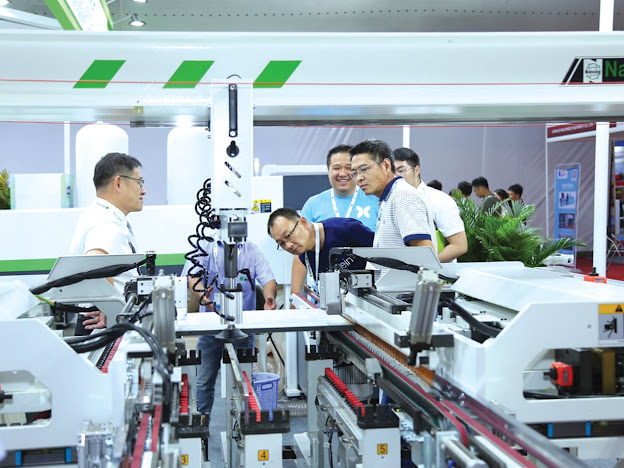
Modern and intelligent machinery helps optimize work processes and improve product quality. and save time and costs for the timber industry.
Although sea freight costs have decreased, they remain high, directly impacting businesses' export capabilities.
In addition, container shortages and limitations in the logistics system are exacerbating difficulties in transporting goods. Companies in the logistics and shipping sectors are facing rising costs due to inflation and labor shortages.
Despite declining demand from the US and EU markets, Vietnam's wood industry still benefits from significant growth in the Chinese market. Furthermore, free trade agreements (FTAs) such as CPTPP, EVFTA, and RCEP have opened up opportunities for Vietnamese wood businesses to easily access new markets and benefit from reduced tariffs.
Mr. Nguyen Truong Thi, Deputy Director of the Department of Industry and Trade of Binh Duong province, emphasized that the US market is very important to Vietnam's wood industry, accounting for more than 50% of the total wood export turnover.
During his previous term, Donald Trump implemented numerous protectionist measures when Vietnam had a large trade surplus with the US, including requiring Vietnam to increase imports from the US to reduce the surplus and adjusting exchange rate policies. Therefore, with Trump's re-election, the Vietnamese timber industry may continue to face similar challenges but may also seize new investment and development opportunities.
Workers