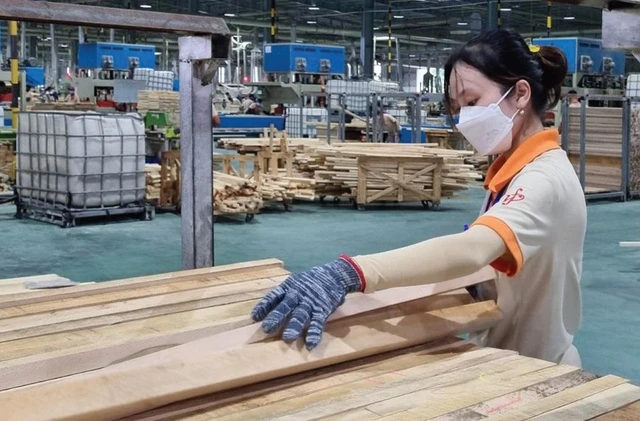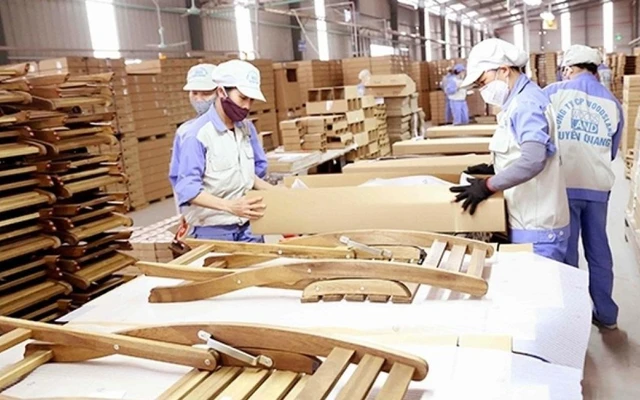

Amidst a slowdown in wood and wood product exports in the second quarter, most businesses in the industry maintained their year-to-date growth momentum, but some experienced decreased profits or even reported losses.
According to statistics from the General Department of Customs, the export value of wood and wood products in the second quarter of 2022 reached US$4.4 billion, a decrease of 0.41% compared to the second quarter of 2021. Of this, the export value of wood products in the second quarter of 2022 reached US$3.06 billion, a decrease of 11.51% compared to the same period last year.
Overall, in the first six months of 2022, the export value of wood and wood products reached US$8.4 billion, an increase of 1.71% compared to the same period in 2021. Of this, exports of wood products reached US$6.06 billion, a decrease of 5.81% compared to the same period in 2021.
Previously, in 2021, the wood industry achieved spectacular results, setting a record export of $14.5 billion, an increase of 181% compared to 2020. In the first months of 2022, exports of wood and wood products continued to grow very positively, reaching approximately $7 billion in the first five months, an increase of 4.61% compared to the same period. However, Vietnam's wood product exports, especially the main export items, began a fairly sharp decline from May 2022.
According to the Vietnam Wood and Forest Products Association (Vifores), since May, wood furniture exports to both the US and China have decreased sharply. Vietnam is the third largest supplier of wooden furniture to China. However, wood furniture exports to China in the first months of this year have fallen sharply, with a decrease of more than 211 TP3T, mainly due to the impact of the pandemic and the "Zero COVID" policy which has made customs clearance difficult.
Meanwhile, in the US market (accounting for 60% of Vietnam's wood and wood product exports), excessively high inflation is also significantly impacting the Vietnamese wood industry, as many importers in the US have reduced their wood product purchases.
Second-quarter profits are starting to diverge.
Amidst a slowdown in wood and wood product exports in the second quarter, the revenue and profits of wood industry businesses have diverged; while most remained profitable, some experienced decreased profits or even reported losses.
Leading the group of wood businesses reporting profits in the second quarter is An Cuong Wood Joint Stock Company (ACG) with net revenue reaching VND 1,059 billion and after-tax profit reaching VND 159 billion, an increase of 151% and 16.31% respectively compared to the same period in 2021.
Overall, in the first six months of the year, An Cuong Wood recorded revenue of VND 1,915 billion, an increase of 121%; net profit after tax reached VND 297 billion, an increase of 17.71% compared to the same period last year.
In 2022, the company set a revenue target of VND 4,242 billion and a net profit target of over VND 550 billion. Thus, after 6 months, An Cuong Wood has achieved over 451% of its revenue target and 501% of its profit target for the entire year.
Savimex Economic Cooperation and Import-Export Joint Stock Company (SAV code) also announced that its net profit after tax in the second quarter increased by 128% compared to the same period last year, reaching VND 24.3 billion, and revenue increased by 201% to VND 292.3 billion.
After the first half of 2022, the company's net revenue reached VND 566 billion, an increase of over 81% compared to the first half of last year. Pre-tax profit (PTP) and after-tax profit (NPAT) reached VND 46.4 billion and VND 37.2 billion respectively, both increasing by 77% compared to the same period.
Thus, compared to the target of achieving full-year revenue of VND 1,080 billion and pre-tax profit of VND 56 billion, after half a year, Savimex has achieved more than 521% of the revenue plan and nearly 831% of the pre-tax profit target.
Duc Thanh Wood Processing Joint Stock Company (code GDT) also recorded double-digit revenue and profit growth in the second quarter, with net revenue reaching nearly VND 131 billion, an increase of 13.51% compared to the same period last year, and net profit after tax reaching VND 23.2 billion, an increase of 20.41%.
For the first half of 2022, Duc Thanh Wood achieved net revenue of VND 239 billion, an increase of 10.71% compared to the same period last year, and after-tax profit of VND 44.6 billion, an increase of 19.81%.
In 2022, Duc Thanh Wood set a target of 500 billion VND in net revenue and 94.3 billion VND in net profit. Thus, in the first six months of the year, the company achieved 47.81% of its revenue plan and 47.31% of its profit target.
Similarly, Phu Tai Joint Stock Company (PTB) also recorded continued revenue growth of nearly 181% in the second quarter, reaching VND 1,899 billion, and net profit after tax increased by 24.6% compared to the same period last year, reaching VND 159 billion. For the first half of the year, the company reported net revenue of VND 3,618 billion and net profit after tax of VND 304.6 billion, representing increases of 201% and 32.4% respectively compared to the same period last year.
Despite relatively good growth in the first six months of the year, Phu Tai plans for revenue of 1,593 billion VND and pre-tax profit of 166 billion VND in the third quarter, representing decreases of 7.91% and 20.41% respectively compared to the performance in the third quarter of 2021.
In 2022, the company planned for consolidated revenue of VND 7,250 billion and net profit of VND 632 billion. After 6 months, the company had achieved 49.91% of its revenue target and 48.21% of its profit target for the whole year.
Slightly less impressive, Thuan An Wood Processing Joint Stock Company (GTA) announced net revenue in the second quarter reaching nearly VND 183 billion, an increase of 101% year-on-year, and after-tax profit reaching nearly VND 6 billion, an increase of 21% year-on-year. For the first six months of the year, the company recorded net revenue of nearly VND 321 billion, an increase of 121% year-on-year, and after-tax profit of VND 11 billion, an increase of 71% year-on-year.
While most timber businesses maintained good performance, some, despite recording revenue growth, experienced a significant decrease in profits due to rising cost of goods sold.
For example, VRG Quang Tri MDF Wood Joint Stock Company (code MDF) reported that net revenue in the second quarter still increased by 241% compared to the same period last year, reaching VND 363.4 billion, but after-tax profit decreased by 211% to VND 20.8 billion.
For the first six months of the year, the company achieved net revenue of VND 680.4 billion, an increase of 121% compared to the same period last year. However, net profit after tax decreased by 491% compared to the same period last year, down to VND 24.2 billion.
According to the company's explanation, the input material prices for MDF production increased 2.67 times in the first six months of the year, with citric acid and urea increasing more than twofold compared to the same period last year.
Conversely, after four consecutive quarters of profit, in the second quarter of 2022, Truong Thanh Wood Industry Group Joint Stock Company (TTF) recorded a net loss of VND 10.8 billion, compared to a profit of VND 42 billion in the same period last year. Net profit attributable to parent company shareholders was negative VND 6.8 billion, while the profit in the same period last year reached VND 42.8 billion.
During the period, although Truong Thanh Wood's net revenue increased by 42.31% to nearly 623 billion VND, the cost of goods sold also increased by nearly 501% to 548.2 billion VND, coupled with a surge in financial expenses (mainly interest expenses) to 33 billion VND, a sharp increase in selling expenses to 43 billion VND, and especially a 7.8-fold increase in administrative expenses to 40.7 billion VND, and a 2.5-fold increase in other expenses to 12.4 billion VND.
Explaining the reason for the sharp decline in profits, the leaders of Truong Thanh Wood said that it was mainly due to the company's gross profit from sales and services decreasing from 91% to 61% in the quarter.
Despite a loss of VND 10.8 billion in the second quarter, the company still reported a net profit of VND 7.76 billion for the first six months of the year, a significant increase compared to VND 2.7 billion in the same period of 2021. Revenue also increased by 54.5% to VND 1,159 billion.
This year, Truong Thanh Wood aims for consolidated revenue of 2,268 billion VND and net profit of 72 billion VND. After the first half of the year, the company achieved 51.11% of its revenue target but only 10.81% of its profit target.
High inflation is negatively impacting the timber industry.
After relatively positive growth in the early months of the year, exports of wood and wood products have shown signs of decline in recent months, especially since the beginning of the third quarter.
According to data from the Vietnam Wood and Forest Products Association (Vifores), the export value of wood and forest products in July was estimated at US$1.41 billion, a decrease of 5.51% compared to June 2022 and a decrease of 1.61% compared to the same period in 2021. Overall, the export value of wood and forest products in the first seven months of 2022 was estimated at US$10.42 billion, an increase of 1.31% compared to the same period in 2021.
The US, Japan, China, the EU, and South Korea continue to be the main export markets, with the total export value to these five markets estimated at $9.38 billion, accounting for 90% of the country's total export value.
Of that total, exports of wood and forestry products to the US reached over $5.84 billion, a decrease of 4.91% compared to the same period in 2021, with wood and wood products alone reaching $5.58 billion, a decrease of 5.11%.
Wood exports to Japan reached US$1.04 billion, an increase of 19.41% compared to the same period in 2021; wood exports to China reached US$1.161 billion, an increase of 23.81% compared to the same period in 2021.
According to Vifores, export growth in the first seven months of the year was lower than the same period in 2021 and previous years, mainly due to the high increase in raw material and product prices (sharply increased production and transportation costs); and countries tightening credit policies due to rising inflation, leading to a sharp decrease in consumer demand.
Vifores assesses that rising inflation in the US, European, and UK markets is directly and negatively impacting the production and business operations of wood industry enterprises.
A quick survey of 52 wood industry businesses conducted by Vifores in collaboration with Forest Trends revealed that, among the 45 businesses currently exporting to the US, 33 reported a decrease in current revenue of nearly 401 TP3T compared to the first months of the year. Only 10 businesses reported an increase in revenue compared to previous months, however, the increase was very small (111 TP3T).
In the EU market, out of 38 participating businesses, 24 reported a revenue decrease of over 411 TP3T compared to previous months. Only 4 businesses reported an increase in revenue, at 141 TP3T. In the UK market, out of 25 participating businesses, 17 reported a revenue decrease, at over 411 TP3T.
Approximately 711 businesses reported that orders will continue to decline from now until the end of the year. According to their assessment, given the current market conditions, 441 businesses believe their revenue will decrease by approximately 441 businesses for the entire year of 2022.
With the assessment that the wood industry will face many difficulties ahead, in a recent report, VNDirect Securities forecasts that the gross profit margin of wood and furniture companies in 2022 will be affected due to supply shortages that will continue to push up raw wood prices in 2022.
Accordingly, VNDirect forecasts that this year, the gross profit margin of wood and furniture companies will continue to decrease by 0.4-0.6 percentage points.
Furthermore, high logistics costs could impact the gross profit margins of wood and furniture companies in 2022. Although shipping costs showed signs of cooling down from April 2022, decreasing by 10% compared to the previous month, VNDirect forecasts that logistics costs will remain high, approximately US$7,000/40ft container in 2022 due to current high oil prices.
However, VNDirect believes that one bright spot that could improve the revenue and profits of wood industry businesses is the domestic market, thanks to the prospects of the real estate sector.
This securities firm expects the real estate market to see a recovery in supply in 2022, as developers will focus on boosting sales to improve cash flow.
VNDirect expects the residential real estate market in Ho Chi Minh City and Hanoi to recover strongly in 2022-23. Accordingly, the supply of new apartments in Ho Chi Minh City will recover strongly from 60-70 units in 2022-23 to 22,000 units in 2022 and approximately 34,000 units in 2023. Meanwhile, the supply of new apartments in Hanoi will increase from 40-50 units in 2022-23 to 25,600 units/36,000 units.
VNDirect expects leading wood manufacturers with large customer bases such as ACG and TTF to take advantage of the recovery of the residential real estate market.
According to Dinh Thom
Business Life